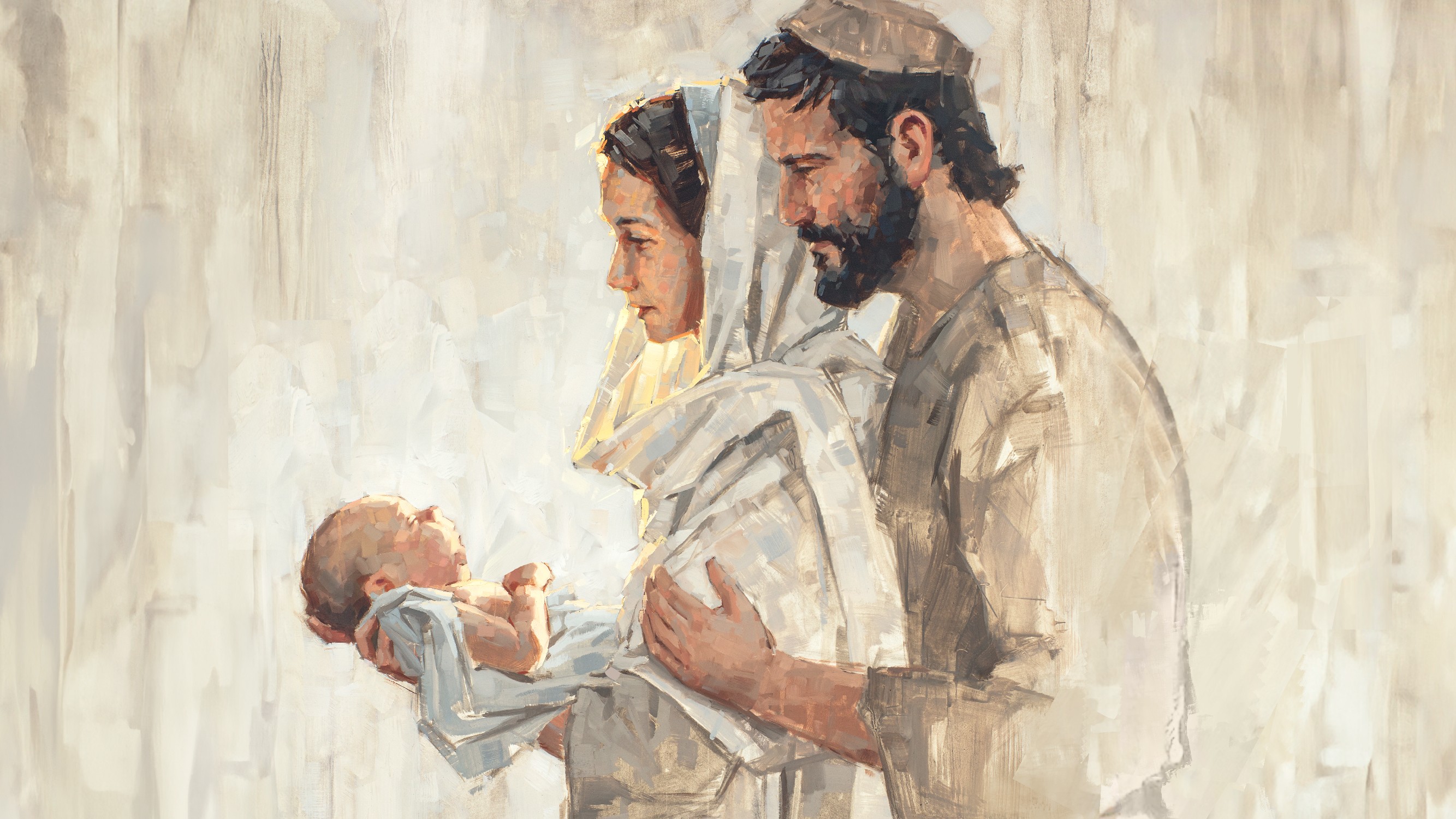
This will be my tenth year writing a Christmas message, and I am only now focusing on Joseph. I have even covered Simeon, La Befana, and King Herod. It honestly never occurred to me to focus on Joseph. In a way, I was proving my own point without even realizing it.
Every year, I set out to look at the nativity story in a totally new way. It is an exercise that breathes new life into Christmas. And this year, I am grateful for Joseph. He taught me a lesson I really needed. He taught me to forget about myself and to focus on Jesus. I have been surprised by how liberating it is and how it takes the pressure off the whole season. So let’s finally talk about Joseph!
Included below is the Joseph’s Christ-Centered Christmas ministering message, a printable, and a cute Christmas ornament idea that goes with the message.
Joseph’s Christ-Centered Christmas
When we think of the Christmas story, Mary, the shepherds, and even the wise men take center stage. Although Joseph plays a central role, we hardly think about him. Mentions of him in scripture are few, hymns rarely focus on him, and in nativity pageants, he often looks just like a shepherd.
Christmas is never about Joseph, even though he is a major contributor. He is the doer, the protector, and the one who quietly helps God’s plan unfold. He is always present – acting on angelic dreams, guiding his family, and putting Jesus first. Even when following these promptings made his life harder or more uncertain, Joseph never made it about himself. He is an unsung hero of the nativity story.
It is easy to fall into the trap of making Christmas about us. Maybe we want to impress others with the gifts we give. Or maybe we focus too much on the gifts we get. We work to impress others with perfect decorations or fancy meals. We might carefully curate what we post on social media to show ourselves in the best light. Christmas programs and performances might become more about impressing others with our talents than worshipping Christ. Maybe we fall into the trap of overindulgence, whether it is shopping, eating, or even over-planning. Perhaps we feel bad if our holidays don’t measure up to others.
When we get caught up in perfection, comparisons, or overindulgence, Joseph reminds us that Christmas is never about us, it is always about Christ. Centuries later, his example continues to show us how to celebrate Christmas.
Joseph Puts Others Before Self
We first get a sense of what kind of man Joseph is when he learns Mary is pregnant. Mary was espoused to Joseph, and this was a much more binding agreement than today’s engagements. In Jewish culture, a couple would already be considered husband and wife. It was a legal contract and required a bill of divorcement to terminate the agreement.
Couples were typically espoused for about a year. The husband prepared their future home, while the wife remained in her father’s house, gathering her dowry and proving her faithfulness. At the end of that time, the husband would go to his father-in-law’s home to come for his bride. There would be a marriage feast for several days, and the couple would enter their home together.
However, things were not going to go according to plan. When Joseph found out that Mary was pregnant, I imagine he was devastated and humiliated. The traditional way to restore his honor was to publicly expose Mary. Instead, he opted for the most private form of divorce, personally delivering the letter of divorcement to her in the presence of two witnesses. Under the law, he was not even obligated to share his reasons with the witnesses.1
Instead of thinking of himself, Joseph wanted to soften the repercussions for Mary as much as possible. According to Biblical law, adultery was punishable by death. Even though the sentence was rarely carried out during Roman rule, there would have been many other serious social consequences.2 Women who committed adultery would have faced social isolation, loss of reputation, economic hardship, humiliation, and an inability to marry later.
But Joseph decided to put aside his own ego and reputation to make things easier for Mary, even before knowing her innocence. Understanding the cultural and legal context of his time — especially the nature of their espousal — helps us see how he was willing to sacrifice his own pride to protect Mary.
Joseph is a Just Man
When Joseph decides to divorce Mary privately, Matthew 1:18 describes him as a “just man.” This word is significant and reveals an essential part of Joseph’s character.
The New Testament uses the Greek word dikaios, or just, to describe someone who aligns their life with God’s will. This includes qualities such as faithfulness, compassion, humility, and obedience. For example, it isn’t enough to only be obedient; you also need to show compassion to others. Joseph embodied both of these traits when he decided on a private divorce. He was showing obedience to the Torah while also extending mercy to Mary. When we are truly aligned to God’s will, righteousness includes both justice and compassion.
As the earthly father of our Savior, Joseph’s example of justice and compassion gives a richer context to Jesus’s ministry. Jesus looked beyond social station or perceived righteousness to see the very heart. He responded with compassion to the sinner, the downtrodden, and the oppressed. And through the Atonement, Jesus Christ would fulfill the demands of both justice and mercy. In doing so, He brought, “about the plan of mercy, to appease the demands of justice, that God might be a perfect, just God, and a merciful God also” (Alma 42:15).
Joseph Acts Without Fear
As Joseph responds with compassion, it sets the stage for later divine manifestations. By not focusing on himself, he shows that he is prepared for greater responsibilities. Joseph is saved from having to divorce Mary when an angel appears to him in a dream. He tells Joseph that he doesn’t need to be afraid of taking Mary as his wife; she has been faithful. She conceived by the power of the Holy Ghost and is carrying the promised Messiah.
Joseph was likely relieved that Mary had been faithful, but taking her as his wife would expose him to further scrutiny. The timing of the birth would raise questions and Joseph’s own conduct would be under suspicion as well. But if Joseph worried about his image or his lack of preparation, we do not see it in the text. As soon as Joseph rises from his sleep, he follows the angel’s instructions and takes Mary as his wife.
After their marriage, Joseph and Mary lived together, but they did not consummate their marriage until after Jesus was born (Matthew 1:25). At that time, it was his right as a husband, and it would have been expected. But he put all that aside, showing deep respect for God, Jesus’s divine origin, and Isaiah’s prophecy of a virgin birth.
Joseph’s ready acceptance of the angel’s message and his quickness to act on that revelation shows profound faith in God and courage. Regardless of what was socially appropriate, he was willing to put all that aside for the Lord. Joseph does not make it about him, and he moves forward without fear.
Joseph Names Him Jesus
One of the first things that Joseph does for Jesus is that he gives him a name (Matthew 1:25). This act has an interesting double significance.
First, naming a child was the right of the father. But Joseph willingly forfeits this right when the angel tells him that the baby is to be called Jesus. The name is significant because it means “Jehovah saves.” In pre-mortality, Jesus was Jehovah, and in mortality, this form of His name testifies of His role as the Savior of the world.
Joseph could have insisted on a family name, but instead, he obediently follows the angel’s direction. Joseph accepts everything with such grace that we forget it goes against so many of the social norms of that day.
Second, it is significant that it is Joseph who names Jesus. Naming was considered a legal act by the father, recognizing the child as his own. In this way, Jesus is adopted into Joseph’s line, thereby making him legally of David’s royal line.
This title was an important part of the Messianic prophecies. In fact, when the angel visits Joseph, he calls him “son of David,” making a reference to this lineage. The succession of kings was always traced by the father’s line, not through the mother’s.3 So, regardless of Mary’s lineage, Jesus needed to be legally claimed by Joseph to be from the Davidic line. This made Christ a son of earthly kings and of our Heavenly King.
Once again, Joseph puts himself aside and acts in accordance with God’s plan. He plays his role, even when that role goes contrary to societal expectations.
Joseph Arises When Prompted
According to what we have in scripture, an angel visits Joseph in a dream at least four times. The first time was when the angel instructed Joseph to marry Mary. The second vision happens after the wisemen visit the family. When their visit prompts Herod to look for the child, an angel tells Joseph to flee with his family to Egypt. After his dream, we again see Joseph respond without hesitation. In fact, it appears that they left immediately while it was still night.
We don’t know very much about their journey, but thinking about some of the things they might have faced helps us identify more with their struggles. A shortened engagement could have meant that they were less prepared for their growing family. Joseph might not have had time to prepare a home. There is a chance that their marriage circumstances might have made some family and friends unwilling to help. Even before Christ is born, things were probably already uncertain and uncomfortable for Mary and Joseph. That can take a toll on you.
When they fled to Egypt, they probably settled about 250 to 350 miles away where there were large Jewish populations. Christ was probably older than 40 days (when he was presented at the temple) and younger than two years old. Traveling with a child that young is challenging and would have slowed things down. The journey could have taken up to a month. It is possible that Mary and Joseph did not have very much in terms of wealth besides what they were given by the wisemen. And they would have had to leave without much preparation.
The third recorded dream was when the angel appeared again to Joseph and told him it was safe to return because King Herod was dead. When they returned, Joseph learned that Archelaus, the son of Herod, was ruling in Judea. Archelaus had a reputation for brutality, and Joseph was scared. He then had a fourth dream when the angel warned him not to go there, but to return to Nazareth instead. This also fulfills the prophecy that Christ would be called a Nazarene.
Again and again, Joseph thoughtfully analyzes the situation and then responds to divine guidance. There were lots of times he could have hesitated or sought a different answer, but he trusts in God more than he does in himself. He acts without hesitation. By following promptings, Joseph put his family right where God needs them. Joseph does not think of how things will reflect on him or impact his own comfort, safety, and convenience. His focus is on Jesus.
Joseph Shows Us How to Celebrate Christmas
I think one of the reasons we don’t focus on Joseph was that Joseph never focused on himself. Joseph shows us that the way to celebrate Christmas is to step out of the spotlight and make room for Christ. It is not about perfection or perception; it is about putting Christ first. Joseph’s steady faith, his willingness to sacrifice reputation and comfort, and his readiness to act on divine guidance teach us how to center our lives on the Savior. When we choose compassion over pride, courage over fear, and discipleship over self-promotion, we honor Christ just as Joseph did.
Joseph’s actions bear powerful testimony of Jesus Christ. He would not have done what he did unless he believed Jesus was the promised Savior. Like Joseph, I can bear testimony of Christ through my actions by following God’s promptings this Christmas season. I can focus on Christ without worrying how it might impact my own plans or the perceptions of others.
Sources
- Alfred Edersheim, The Life and Times of Jesus the Messiah, “The Annunciation of Jesus the Messiah, and the Birth of His Forerunner,” 1.154
- Alfred Edersheim, The Life and Times of Jesus the Messiah, “Crucified, Dead, and Buried,” 2.584
- Huntsman, Eric D. Good Tidings of Great Joy. Salt Lake City: Deseret Book, 2011, 29.
“Joseph’s Christ-Centered Christmas” Christmas Ministering Printable
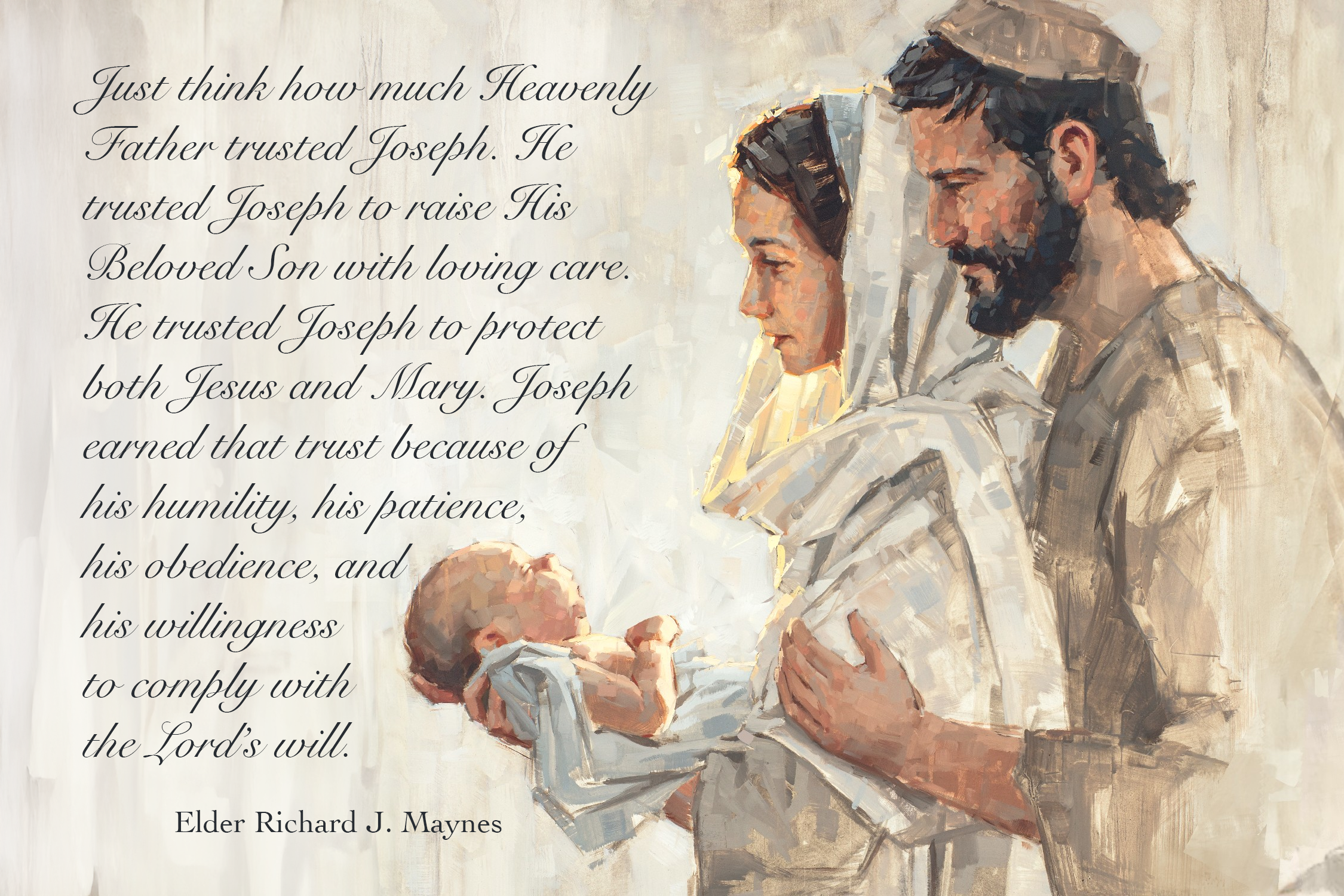
Download “Joseph’s Christ-Centered Christmas” Christmas Ministering Printable (4×6)
You can print these printables as 4×6 photo prints. My local drug store prints them for just pennies. Artwork / Source
“Joseph’s Christ-Centered Christmas” Christmas Ornaments
It is finally time to add Joseph to my “Nativi-tree.” Each year I add an ornament to the tree that captures a new insight I’ve gained about Christmas. Alongside it, the tree is filled with nativities and ornaments bearing the different names of Christ.
I decided to do a carpenter’s hammer to represent Joseph. I love that it focuses on his gift of creating. It is a reminder of how his efforts contributed to building the Lord’s Kingdom.
These were really easy and inexpensive to do. I bought little wooden hammers from Amazon, the kind they use on those breakable chocolate hearts. The handle was too long, so I cut it shorter and then I stained it with Watco danish oil. To hang them, I tried two different ways. For one, I drilled a small hole in the handle and hung it upside down. For the other, I used a screw eye hook that I screwed into the top. I drilled a small pilot hole at the top to make it easier to screw them in.
I decided to hang a little nativity charm from the ribbon with Joseph looking over Mary and Jesus.




Did you like this December’s “Joseph’s Christ-Centered Christmas” Ministering Message? Find more Relief Society Ministering Printables for the Church of Jesus Christ of Latter-day Saints.
These ministering printables are a great way to help families incorporate the “Come, Follow Me” lessons into their own study. They are also perfect for Young Women’s, Relief Society, Sunday School, or Family Home Evening. I hope that these ministering printables will be a simple way to reach out to those we minister to.